Market Scenario
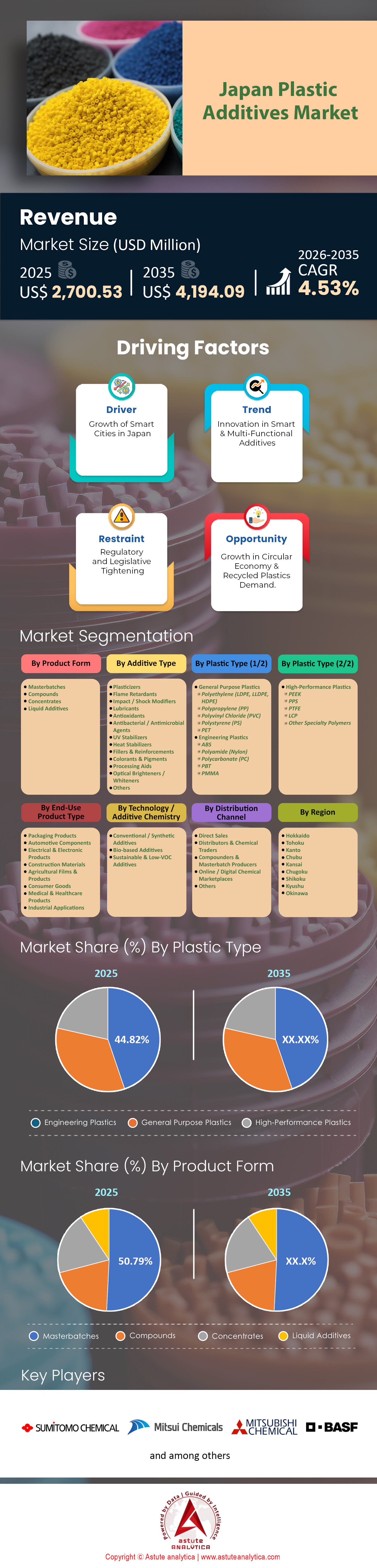
Japan plastic additives market size was valued at USD 2,700.53 million in 2025 and is projected to hit the market valuation of USD 4,194.09 million by 2035 at a CAGR of 4.53% during the forecast period 2026–2035.
Key Findings Shaping the Market
- By product form, masterbatches accounts for 50.79% of the Japan plastic additives market in 2025.
- By additive type, fillers & reinforcements generates the largest 14.02% revenue share of the market.
- By plastic type, engineering plastic with over 44.82% market share emerged as the largest plastic type in the Japan plastic additives market.
- By end use products, packaging Products generates the highest 23.67% revenue of the market in 2025.
- By distribution channel, direct sales accounts for over 38.47% sales of the plastic additives in Japan.
- By region, Kanto with over 34.03% market share emerged as the largest contributor to Japan plastic additives market.
Japan Plastic Additives Market Pivots: Value Over Volume Amid Production Dip
The Japan plastic additives market is executing a high-value pivot as domestic feedstock production hits historic lows. Ethylene output contracted to 4.99 million tons in 2024, representing a sharp 6.3% year-on-year decline. Total production for the five major plastics subsequently fell to 5.7 million tons. Such contraction forces the industry to decouple profitability from virgin resin volume. The demand is now driven by "additive intensity"—the increased ratio of functional chemicals required per ton of finished product. Domestic demand tracked at a low 3.92 million tons ethylene equivalent. Japanese crackers frequently operated below the critical 80% capacity utilization threshold throughout 2024. These figures represent the lowest activity levels seen in approximately 10 years.
Stakeholders are responding by abandoning volume-based strategies in favor of high-performance formulations. The Japan plastic additives market is witnessing a structural transformation where value is generated through functionality rather than mass. Additives that enhance durability, thermal stability, and recyclability are commanding premiums. Manufacturers are retrofitting existing polymer chains to meet rigorous new specifications. This shift explains why the additive sector remains robust despite the upstream petrochemical contraction.
To Get more Insights, Request A Free Sample
Feedstock Scarcity Fuels High-Margin Specialty Additive Growth
Corporate restructuring is accelerating as major players adapt to the new feedstock reality. Sumitomo Chemical announced the closure of 2 MMA/PMMA production lines in Singapore by September 2024. These closures directly impact the regional supply chain for polymer modifiers. Resources are being aggressively reallocated toward high-margin specialty additives. On December 18, 2024, Sumitomo further announced the transfer of PP compound shares in China. Divesting these commodity assets allows capital to flow into specialized segments where the Japan plastic additives market holds a competitive advantage.
Operational efficiency is now the primary survival metric. Companies are streamlining portfolios to focus on "Sustainable Solutions" rather than bulk chemicals. The industry is moving away from generic plasticizers toward complex stabilizing agents. Suppliers are recalibrating for a market with lower virgin feedstock availability. Success now depends on maximizing the performance of limited resin supplies. Consequently, the Japan plastic additives market is evolving into a specialty-driven sector defined by technological sophistication.
Strict Automotive Recycling Mandates Ignite Advanced Compatibilizer Demand
Automotive regulations are acting as the single largest catalyst for technical innovation. On March 31, 2025, the industry consortium published the "Action Plan for the Development of a Recycled Plastics Market for Automobiles." New rules mandate a 15% minimum recycled plastic content for vehicles manufactured between 2031 and 2035. Targets escalate to 20% for the 2036–2040 period. By 2041, the 20% requirement applies universally to all vehicles manufactured domestically. The Japan plastic additives market is seeing a surge in demand for compatibilizers that enable these recycled materials to meet safety standards.
Engineering plastics are central to this automotive evolution. Market volume for these resins reached an estimated 2.20 million tons in 2025. Forecasts suggest a rise to 2.71 million tons by 2030, driven by electric vehicle adoption. Tosoh Corporation committed 75 billion Yen to expand chloroprene rubber production to serve this sector. Such investments confirm that the Japan plastic additives market is prioritizing high-performance mobility applications. Additives must now facilitate lightweighting and thermal stability in next-generation transport.
Government Billions Accelerate Circular Economy Shifts in Stabilizer Markets
State-sponsored financial injections are actively scaling recycling infrastructure. METI allocated 30 billion Yen for circular economy support over a 3-year period starting in 2024. The nation recorded 9.24 million tons of recycled plastics in 2023. Strategic goals aim to increase this figure to 14.07 million tons by 2030. Achieving the "double recycled content" milestone set for 2030 requires sophisticated stabilizing agents. These additives are essential for preventing polymer degradation during the thermal stress of reprocessing in the Japan plastic additives market.
Cross-sector alliances are rapidly implementing these technologies. Koushi Chemical Industry completed its Mie RP Plant in 2024 to enhance material recycling. By February 2025, 42 companies had joined the Shionogi Pharma/Koushi Chemical project to recycle label liners. Such collaborations drive demand for specialized additives capable of handling mixed waste streams. The sector is moving beyond simple mechanical recycling toward chemical solutions. The Japan market is now integral to the national infrastructure for resource circulation.
EV Battery Safety Regulations Propel Flame Retardant Revenue Surge in Japan Plastic Additives Market
Safety regulations are driving massive capital expenditure in the flame retardant segment. This sector was valued at USD 614 million in 2024. Projections indicate revenue will jump to USD 824.9 million in 2025. Tosoh Corporation announced a capacity increase of 22,000 tons per year for chloroprene rubber to support this demand. Construction for the new facility begins in 2027. Commercial production is scheduled to start by 2030. These long-term commitments highlight the critical role of the Japan plastic additives market in vehicle safety.
Global players are positioning themselves to capture this growth. Clariant expanded 2 production lines in Cangzhou to serve high-end stabilizer needs. Meanwhile, ADEKA set a strict 10.5% ROIC target in its "ADX 2026" plan. The company is channeling investment into high-margin flame retardants. Electric vehicle battery components require these advanced materials to prevent thermal runaway. As safety standards tighten, the Japan plastic additives market for flame retardants is becoming the most lucrative sub-sector for chemical manufacturers.
Semiconductor Boom Drives Massive Expansion in High-Purity Electronic Additives
The resurgence of domestic semiconductor manufacturing is creating a boom for ultra-pure materials. Tosoh invested 16 billion Yen to increase separation media capacity by 70%. Construction finished in July 2024, with commercial operations starting March 2025. Demand for PET engineering plastics reached 0.60 million tons in 2024, capturing a 28.50% market share. Clariant refocused its 3 business segments to capture these industrial electronics needs. The Japan plastic additives market is increasingly tethered to the electronics supply chain.
Financial results demonstrate the resilience of players serving this high-tech sector. ADEKA reported a record ordinary profit of 35,763 million Yen for FY2024. Net sales hit 399,770 million Yen, with operating profit at 35,428 million Yen. Profit attributable to owners surged 37.0% to 22,977 million Yen. The "ADX 2026" plan targets 115.0 billion Yen in eco-product sales. Strong balance sheets allow these firms to dominate the Japan plastic additives market. Success relies on serving the chip industry while maintaining robust profitability.
National Bio-Plastic Targets Spur Innovation in Fermentation-Ready Additives
Bio-based materials represent a burgeoning technical frontier. The government set a national target to introduce 2 million tons of bio-based plastic products by 2030. Calculations for this goal assume an average biomass ratio between 30% and 40%. Kaneka Corporation is aggressively expanding to meet these specifications. The company targeted a production capacity of 20,000 tons per year for its "Green Planet" biopolymer by 2024. The Japan plastic additives market must now supply formulations that function effectively in these biological substrates.
Kaneka achieved a biomass plasticity index of 74% with new product lines. Production initially started at a modest scale of 1,000 tons. Rapid scaling to the 2024 target highlights the urgent industry demand for eco-friendly alternatives. Additive suppliers must formulate solutions that are compatible with fermentation-based polymers. Conventional additives often fail to perform in high-biomass resins. Innovation is focused on maintaining durability while meeting compostability standards. The market is witnessing a technical revolution in bio-polymer stabilization.
Strategic Asset Liquidation Unlocks Capital for High-Stakes R&D Investments in Japan Plastic Additives Market
Financial strategies are becoming increasingly creative to fund necessary innovation. DIC Corporation is liquidating non-core assets to fund its chemical business expansion. The company plans to sell approximately 280 artworks from its collection. Only about 100 pieces will remain from the original 384 artworks. The objective is to generate 40 billion Yen in cash by fiscal year 2026. DIC reported operating income of 44.5 billion Yen for the fiscal year ended December 31, 2024. Such moves indicate that the Japan market requires significant upfront capital.
Forecasts for fiscal year 2025 predict operating income will rise to 50.0 billion Yen. To maintain investor confidence during this transition, DIC set an annual dividend of 100 Yen per share for FY2024 and FY2025. The capital raised from art sales will directly support R&D in functional additives. Companies are sacrificing legacy assets to secure their future competitive position. These liquidity strategies signal that major players are preparing for a period of intensive investment in the Japan plastic additives market.
Sustainability Metrics and PFAS Bans Redefine Profitability Standards
Leading entities are measuring success through environmental impact rather than volume alone. Sumitomo Chemical targeted 700 billion Yen in sales for "Sumika Sustainable Solutions" (SSS) in FY2024. The long-term vision sets a revenue goal of 1.2 trillion Yen by FY2030. As of August 2024, the company designated 10 new technologies as SSS products. The total portfolio now contains 81 certified sustainable solutions. These products generated actual annual sales of 588.7 billion Yen in 2024. The Japan plastic additives market is pivoting toward these quantifiable green metrics.
The environmental impact of these solutions is significant and measurable. Use of SSS products resulted in 7.10 million tons of CO2 equivalent emissions avoided in FY2023. Regulatory compliance is further driving this shift. By 2025, Japan will enforce bans permitting only government-approved, PFAS-free materials in food packaging. Clariant launched the "AddWorks PPA" line in Spring 2024 to address these shifts. ADEKA aims for 201.4 billion Yen in eco-product sales by fiscal 2030. Future growth in the Japan plastic additives market depends on validating these sustainability credentials.
Segmental Analysis of the Japan Plastic Additives Market
By Additive Type: Fillers & Reinforcements (14.02% Market Share)
Automotive Lightweighting and Recycled Content Goals Propel Reinforcement Demand
Fillers and reinforcements secure their revenue prominence in the Japan plastic additives market by serving Japan’s massive automotive industry, which is aggressively pursuing lightweighting to meet global efficiency standards. Carbon fiber and glass fiber reinforcements are essential for replacing heavy metal components in next-generation vehicles. Toray Industries remains a central figure, expanding its carbon fiber composite materials business to address this surge in mobility applications.
A defining driver for this segment in the Japan plastic additives market is the Japanese government’s rigorous environmental targets; in March 2025, the Ministry of the Environment set a specific goal requiring the automotive industry to use at least 15% recycled plastics in new vehicle production by 2031. This policy immediately accelerates the 2025 demand for high-grade reinforcing fillers that can restore mechanical strength to recycled resins.
Consequently, the domestic market for fiber-reinforced plastics is projected to grow consistently, with the broader engineering plastics volume reaching 2.20 million tons in 2025, supported heavily by these reinforced grades.
By Plastic Type: Engineering Plastic (44.82% Market Share)
Semiconductor and EV Sectors Fuel High-Performance Engineering Plastic Adoption
Engineering plastics command the largest share of the Japan plastic additives market due to their indispensable role in Japan’s advanced technology sectors, specifically semiconductors and electric vehicles (EVs). Unlike commodity plastics, these materials offer the thermal stability and mechanical strength required for miniaturized electronic components. Mitsubishi Chemical Group, in its "Business Strategy Briefing 2025," explicitly targeted the semiconductor manufacturing equipment sector, forecasting a 7% annual market growth for their high-performance engineering polymer applications.
Similarly, Asahi Kasei successfully reduced design times for complex antenna modules using cloud-based polymer engineering, reinforcing the sector's reliance on these advanced materials. The segment is further bolstered by the rapid adoption of fluoropolymers in 5G infrastructure, which are projected to see a CAGR of over 6% starting from 2025. This strategic shift by major chemical conglomerates toward high-margin, functional polymers solidifies the segment's 44.82% dominance.
By End Use Products: Packaging Products (23.67% Market Share)
Circular Economy Mandates and Bioplastics Transform Japan’s Packaging Sector
Packaging remains the top revenue-generating end-use segment in the Japan plastic additives market, driven by Japan’s sophisticated consumer convenience culture and a forceful transition toward sustainable materials. The dominance of this segment is underpinned by the "Plastic Resource Circulation Promotion Law," which escalated in impact during 2025, pushing manufacturers to adopt biodegradable and biomass-based additives. METI (Ministry of Economy, Trade and Industry) announced new packaging certification standards in late 2025, set to launch in January 2026, which incentivize the reduction of virgin plastic use.
This regulatory pressure has catalyzed the bioplastics market, which reached a valuation of USD 926.5 million in 2025. Companies are actively reformulating packaging films with functional additives that maintain barrier properties while enhancing compostability. The sector's revenue share is sustained not just by volume, but by the premium pricing of these next-generation, eco-compliant packaging solutions required by Japan’s strict waste management ecosystem.
Customize This Report + Validate with an Expert
Access only the sections you need—region-specific, company-level, or by use-case.
Includes a free consultation with a domain expert to help guide your decision.
Product Form: Masterbatches (50.79% Market Share)
Precision Colorants and Functional Additives Drive Masterbatch Market Dominance
The masterbatch segment dominates the Japanese market as manufacturers increasingly reject raw pigment handling in favor of dust-free, pre-dispersed granular solutions that ensure consistency. This form is critical for Japan's high-precision plastic molding sectors, particularly in electronics and automotive interiors where color uniformity is non-negotiable.
Major domestic players in the Japan plastic additives market like the newly rebranded artience group (formerly Toyo Ink SC Holdings) and DIC Corporation are pivoting toward high-value functional masterbatches to combat rising raw material costs. According to DIC Corporation’s financial results released in early 2025, the company achieved a robust operating income recovery to ¥44.3 billion (up 148.1%), driven significantly by inventory replenishment in high-performance plastic colorants and pigments. This financial rebound underscores the critical reliance Japanese manufacturers place on advanced masterbatches for quality assurance.
Furthermore, the market size for these specialized coloring agents and additives in Japan reached an estimated USD 350 million in 2025, reflecting steady industrial demand.
To Understand More About this Research: Request A Free Sample
Regional Analysis of the Japan Plastic Additives Market
Kanto Region Commands 34.03% Market Share Spearheading Green Chemical Innovation
The Kanto region dominates the Japan plastic additives market, serving as the strategic heart of the nation’s petrochemical transformation. Its leadership is anchored by the Keiyo Industrial Zone, where manufacturers are aggressively pivoting from legacy feedstock to sustainable alternatives. In August 2025, Sumitomo Chemical operationalized a groundbreaking pilot facility at its Chiba Works to produce propylene directly from ethanol, establishing the region as a hub for next-generation bio-olefin additives.
Simultaneously, Tokyo remains the epicenter of high-value R&D; in October 2025, ADEKA Corporation announced that its advanced clarifier, TRANSPAREX™, received a Guinness World Records™ certification, reinforcing Kanto’s reputation for producing superior functional additives. The region also supports Japan’s premium automotive sector, with May 2025 industry reports highlighting that Kanto-based logistics hubs held the highest inventory of high-grade automotive paint and premium models like Lexus.
Furthermore, Mitsui Chemicals advanced its structural reform in Fiscal 2025 by optimizing its Ichihara Works in Chiba to focus on high-margin green derivatives, securing the region's 34.03% revenue dominance.
Top Recent Developments Shaping the Japan Plastic Additives Market
- Sumitomo Chemical and Prime Polymer Finalize Integration: In December 2025, Sumitomo Chemical and Prime Polymer finalized a definitive contract to merge their domestic polyolefin businesses. This restructuring, aimed for completion in mid-2026, consolidates their polypropylene and polyethylene manufacturing assets to optimize the supply chain for high-performance base resins and additives.
- ADEKA Corporation Launches Record-Breaking Clarifier: In October 2025, ADEKA announced at the K 2025 trade fair that its advanced clarifier, TRANSPAREX™, received Guinness World Records™ certification for the highest transparency in polypropylene. The company initiated a global sales push, positioning this additive as a sustainable replacement for other clear resins.
Top Companies in the Japan Plastic Additives Market
- Adeko Corporation
- The Dow Chemical Company
- Mitsui Plastics, Inc.
- BASF SE
- Clariant AG
- Sumitomo Chemical Co., Ltd.
- DIC Corporation
- Mitsubishi Chemical Corporation
- Sanyo Chemical Industries, Ltd
- Kaneka Corporation
- Other Prominent Players
Market Segmentation Overview
By Product Form
- Masterbatches
- Compounds
- Concentrates
- Liquid Additives
By Additive Type
- Plasticizers
- Flame Retardants
- Impact / Shock Modifiers
- Lubricants
- Antioxidants
- Antibacterial / Antimicrobial Agents
- UV Stabilizers
- Heat Stabilizers
- Fillers & Reinforcements
- Colorants & Pigments
- Processing Aids
- Optical Brighteners / Whiteners
- Others
By Plastic Type
- General Purpose Plastics
- Polyethylene (LDPE, LLDPE, HDPE)
- Polypropylene (PP)
- Polyvinyl Chloride (PVC)
- Polystyrene (PS)
- PET
- Engineering Plastics
- ABS
- Polyamide (Nylon)
- Polycarbonate (PC)
- PBT
- PMMA
- High-Performance Plastics
- PEEK
- PPS
- PTFE
- LCP
- Other Specialty Polymers
By End-Use Product Type
- Packaging Products
- Automotive Components
- Electrical & Electronic Products
- Construction Materials
- Agricultural Films & Products
- Consumer Goods
- Medical & Healthcare Products
- Industrial Applications
By Technology/Additive Chemistry
- Conventional / Synthetic Additives
- Bio-based Additives
- Sustainable & Low-VOC Additives
FREQUENTLY ASKED QUESTIONS
The market was valued at USD 2,700.53 million in 2025. Driven by a strategic pivot toward high-performance functional chemicals, it is projected to reach USD 4,194.09 million by 2035, expanding at a CAGR of 4.53% during the forecast period of 2026–2035.
The industry's March 2025 Action Plan mandates a 15% minimum recycled content for new vehicles by 2031. This regulation has triggered an immediate surge in demand for advanced compatibilizers and impact modifiers, which are essential for stabilizing recycled resins to meet strict automotive safety standards.
With ethylene output falling to a decade-low 4.99 million tons in 2024, stakeholders are decoupling profitability from volume. The market is shifting toward additive intensity, focusing on high-margin, specialty additives that maximize the functionality of limited resin supplies rather than relying on bulk commodity production.
Masterbatches held a 50.79% revenue share in Japan plastic additives market, driven by the high-precision requirements of Japan's automotive and electronics sectors. Manufacturers prefer these dust-free, pre-dispersed solutions over raw pigments to ensure absolute color consistency and operational cleanliness in complex molding processes.
METI’s 30 billion Yen allocation for circular economy support is rapidly scaling the advanced recycling sector. This creates critical demand for thermal stabilizers capable of preventing polymer degradation during reprocessing, supporting the national goal of recycling 14.07 million tons of plastic by 2030.
The domestic chip boom has made engineering plastics (44.82% share) and ultra-pure additives the highest-margin frontier. Major players like Tosoh have expanded separation media capacity by 70%, directly linking additive growth to the rigorous purity standards of the semiconductor supply chain.
LOOKING FOR COMPREHENSIVE MARKET KNOWLEDGE? ENGAGE OUR EXPERT SPECIALISTS.
SPEAK TO AN ANALYST
.svg)

 Schedule a Meeting

Features | Type of License | ||||
 Data Book | Single User |   Multi User |  Corporate | ||
| e-Access | ✓ | ✓ | ✓ | ✓ | |
User Sharing | 1 User Only | 1 User Only | Up to 7 Users | Unlimited User Access | |
⨉ | ⨉ | ⨉ | ✓ | ||
Free Customization | No Free Customization | Up To 30 hrs work | Up To 60 hrs work | Up To 80 hrs work | |
Deliverable |
| ⨉ | ✓ | ✓ | ✓ |
| ✓ | ⨉ | ✓ | ✓ | |
| ⨉ | ⨉ | ⨉ | ✓ | |
Analyst Support | 2-Months Analyst Support | 4-Months Analyst Support | 7-Months Analyst Support | One Year Analyst Support | |
Free Report update in next update cycle | ⨉ | ⨉ | ⨉ | ✓ | |
Free Industry Update (Within 180 days) | ⨉ | ⨉ | ⨉ | ✓ | |
Benefit | Up to 10% off on Post Purchase | Up to 20% off on Post Purchase | Up to 30% off on Post Purchase | Up to 40% off on Post Purchase | |